The Broad Peak Avalanche: Why the Karakoram Is Slipping Earlier Each Season
Warmer summers are altering snowpack behaviour on the world's highest mountains. The consequences show up first as timing, and timing is what avalanche safety depends on.
 Dr. Ivan Petrov 7 min read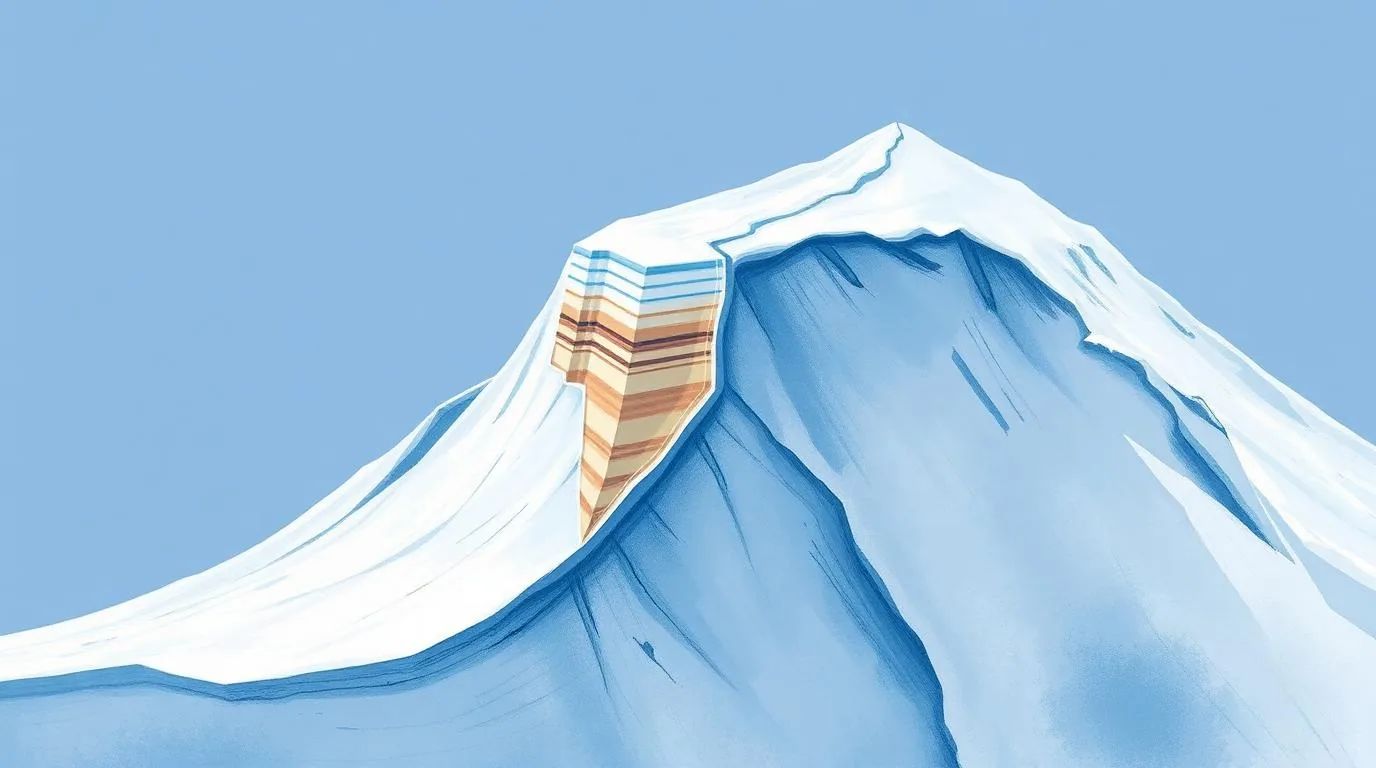
Avalanches on 8,000-metre peaks fall into two broad categories, and the distinction matters enormously for anyone assessing risk. Snow avalanches result from an unstable layered snowpack and can, to a degree, be forecast. Ice avalanches result from serac collapse — the calving of the overhanging ice cliffs that form where a glacier flows over a break in slope — and are effectively unforecastable. A serac fails on the glacier's schedule, not the weather's.
How high-altitude snowpack becomes unstable
- Wind slab: high-altitude wind strips snow from exposed ridges and deposits dense slabs on lee slopes, often over weaker underlying snow.
- Depth hoar: large temperature gradients through a shallow snowpack grow angular, poorly bonded crystals near the base that can persist for weeks.
- Warm-layer weakness: a melt-freeze crust from an unusually warm spell creates a smooth sliding surface for everything deposited above it.
- Loading rate: it is the speed of new snow accumulation, more than the total, that determines whether a slope adjusts or fails.
What is changing in the Karakoram
The Karakoram has long been noted for an anomaly — glaciers that held stable or advanced while most of the world's retreated. That anomaly has weakened. Higher summer freezing levels mean liquid water now penetrates snowpack at altitudes where it previously did not, lubricating weak layers and accelerating serac instability. Climbers and expedition operators consistently report the same practical consequence: the seasonal window that used to feel reliable now shifts earlier and closes less predictably.
You cannot dig a snow pit that tells you when a serac will fall. The only mitigation is to spend less time beneath it.
Mitigation that works, and its limits
- Route timing: crossing exposed sections in the coldest pre-dawn hours, when ice is most firmly bonded.
- Exposure minimisation: choosing lines that spend minutes rather than hours beneath hanging ice, even at the cost of technical difficulty.
- Spacing: parties crossing hazard zones one at a time so a single release cannot take everyone.
- Turnaround discipline: fixed times enforced regardless of how close the summit appears.
Transceivers, probes and airbags — the standard toolkit of recreational avalanche safety — are of limited use above 7,000 metres. Burial depths from a large ice avalanche exceed what companion rescue can recover, and there is rarely anyone unburied nearby to attempt it. At that altitude, avoidance is not the first line of defence. It is essentially the only one.
Was this helpful?
Dr. Ivan Petrov
Science Editor, Lonic
Ivan holds a doctorate in condensed matter physics and worked on superconducting qubit error correction before moving into science journalism.
- Quantum computing
- Physics
- Research policy
Read our editorial standards or send a correction.
Related articles
Nirmal Purja Missing on Broad Peak: What Is Known About the Search
One of the most recognisable figures in high-altitude mountaineering is unaccounted for after an avalanche. A factual account of the incident and the conditions facing rescuers.
Avalanche Safety: The Decisions That Matter More Than the Equipment
Transceivers and airbags save lives. But post-incident analysis keeps finding that the fatal error happened hours earlier, in a decision nobody registered as a decision.

World Cup 2026: Argentina and Brazil Advance as the Expanded Format Takes Shape
Argentina beat Australia 4-1 and Brazil overcame Mexico 2-1. Beyond the scorelines, the 48-team tournament is already revealing what the new structure rewards.

The FIFA Privatisation Debate: What Is Actually Being Proposed
Talk of privatising parts of world football's governing structure has moved from fringe to boardroom. The arguments on both sides are stronger than the shouting suggests.