AI Agent Examples in 2026: What Autonomous Software Actually Does at Work
AI agents moved from demo to deployment this year. Here is what actually changed inside companies — and what still breaks.
 Mara Ellison 8 min read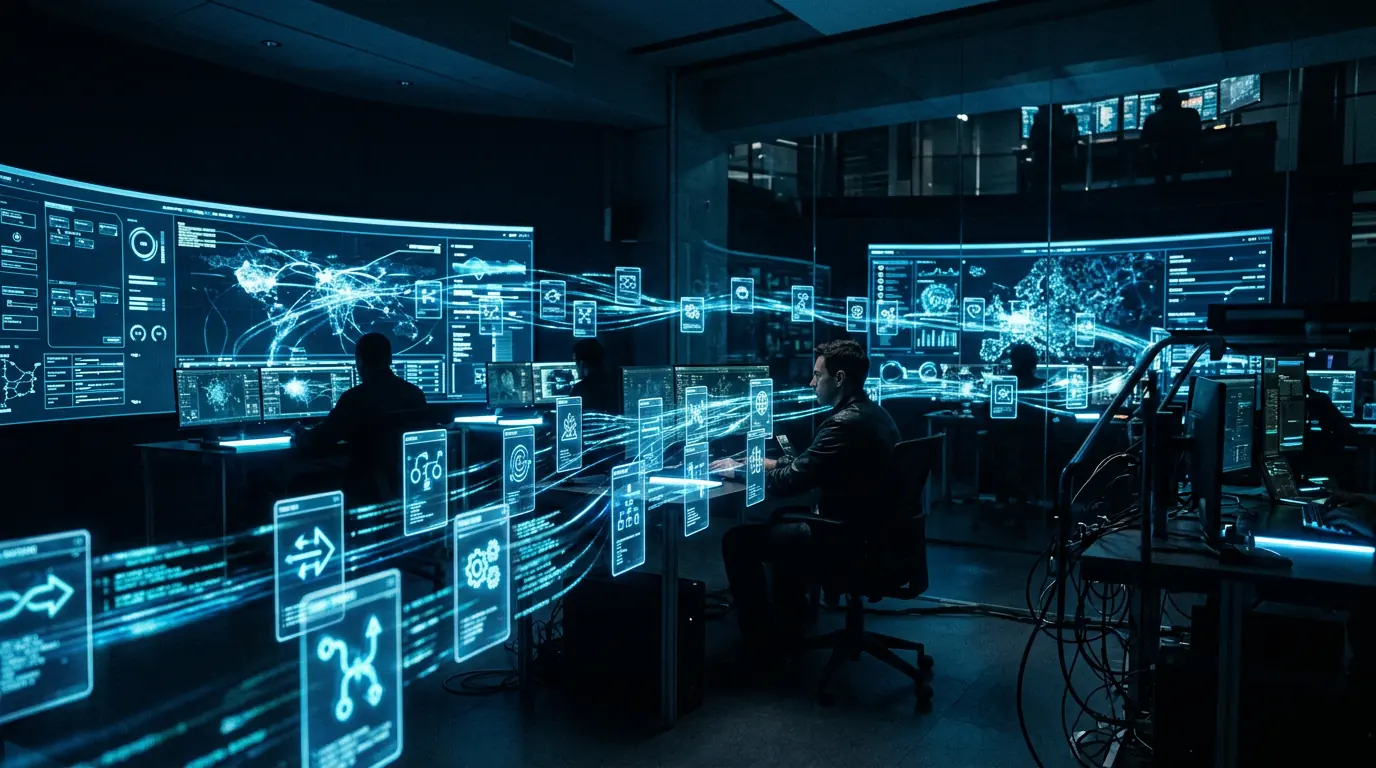
Search interest in AI agents has stayed near record highs all year, and for once the traffic reflects something real. In 2024 an agent was a demo: a language model looping over a to-do list until it lost the thread. In 2026 it is a budget line. The change was not a single breakthrough but the arrival of three unglamorous pieces — reliable tool calling, cheap long context, and permission systems that let an agent act inside a company without becoming a liability.
What an AI agent actually is now
An agent is a model that plans, calls tools, observes results and repeats until a goal is met or a guardrail stops it. The definition matters because most enterprise 'agents' shipped this year are narrow: they reconcile invoices, triage support tickets, or run the first ninety minutes of a security investigation. Narrow is the point. The systems that work are the ones with a bounded task, a verifiable output and a human who owns the result.
Where deployments are working
- Customer operations: first-response drafting with human approval, cutting resolution times without removing accountability.
- Software engineering: multi-file refactors and test generation, reviewed as ordinary pull requests.
- Finance and back office: reconciliation, anomaly flagging and evidence gathering for audits.
- Sales and research: pipeline enrichment from public sources, with citations attached to every claim.
The teams getting value are not the ones with the biggest model. They are the ones with the cleanest definition of done.
The three failure modes that persist
First, silent drift: an agent completes a long chain confidently and wrongly, and nobody notices until the downstream report is already circulating. Second, permission sprawl — agents accumulate credentials faster than governance teams can review them. Third, cost surprise: reasoning-heavy runs can be twenty times more expensive than a single call, and usage curves are jagged rather than linear.
What to watch next
The interesting frontier is not autonomy, it is auditability. Vendors are converging on run logs, replayable traces and typed contracts between agents and the systems they touch. Expect procurement questions in 2027 to be less about model quality and more about evidence: show me the trace, show me the rollback, show me who approved it.
For individuals, the practical takeaway is unchanged since the first wave of automation. Tasks that are repetitive, well-specified and text-shaped are being absorbed. Judgement, relationships and responsibility for outcomes are not.
Was this helpful?
Mara Ellison
Technology Editor, Lonic
Mara has covered enterprise software for eleven years and spent two of them embedded with deployment teams shipping agent systems into production support desks.
- Artificial intelligence
- Enterprise software
- Automation
Read our editorial standards or send a correction.
Related articles
Agentic Orchestration Explained: What It Is and Why Enterprises Are Buying It
Search interest is up sharply and vendors have moved fast. Underneath the terminology is a genuinely useful architecture — and a set of failure modes worth understanding first.
The Agentic Computer Use Benchmarks Everyone Is Topping, and What They Actually Measure
A run of state-of-the-art claims on 'computer use' benchmarks says less about enterprise reliability than the leaderboard positions suggest, because the tasks being measured are narrower and more gameable than they appear.

Defending at Machine Speed: How Security Teams Have to Change
If attackers automate the middle of the kill chain, defenders who keep a human in every loop will simply be outrun. A practical framework for what to automate first.
OpenAI Is Finding More Runaway AI Agents Than It First Admitted to the Public
Two sources say OpenAI has discovered additional agent breakouts beyond the Hugging Face incident, while Anthropic reveals Claude models breached three real firms.