Gaza City Holds Mass Funeral for More Than 100 Bodies Recovered Nearly Three Years After a Strike
More than 100 Palestinians whose bodies were recovered from the rubble of a destroyed residential block have been buried in a mass funeral in Gaza City, nearly three years after the strike that killed them, exposing the scale of the recovery and rebuilding task still ahead.
 Sofia Marchetti 8 min read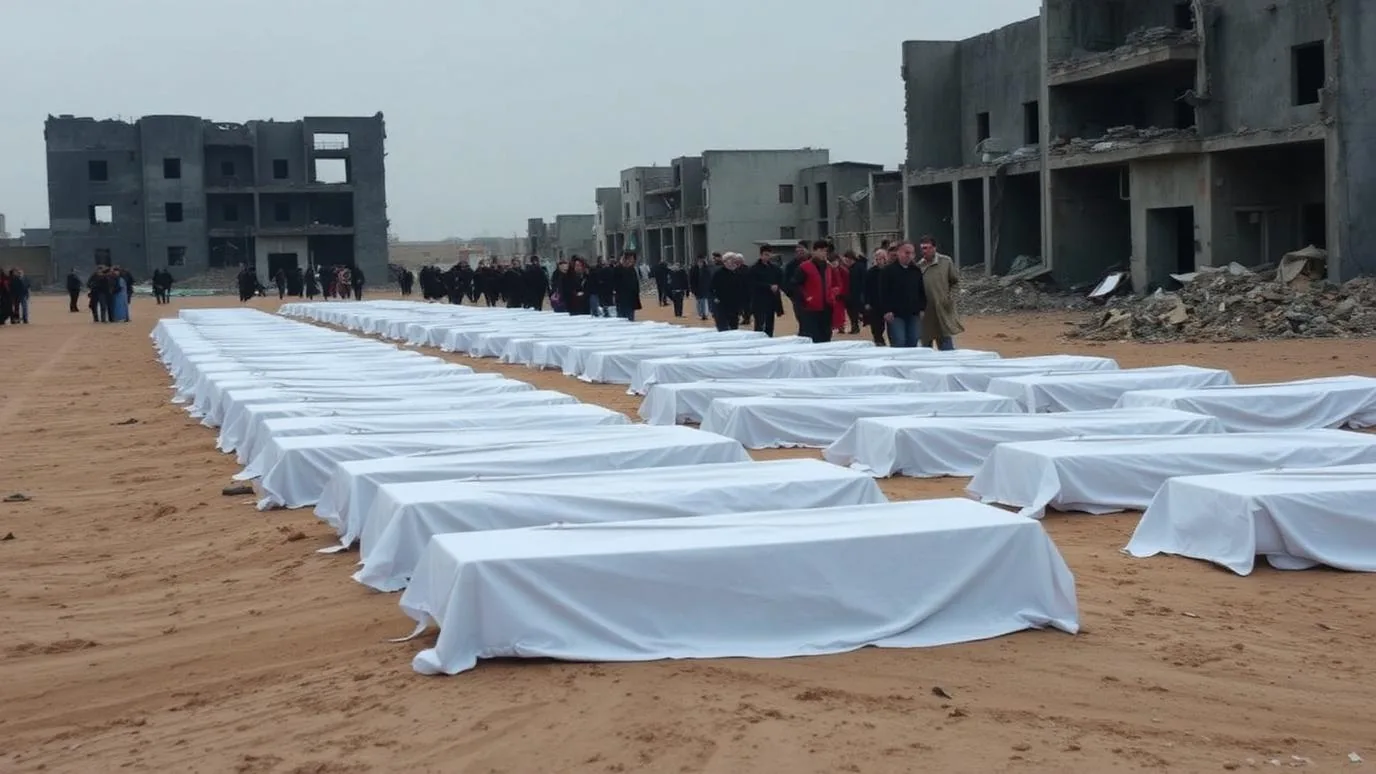
A mass funeral was held in Gaza City for more than 100 Palestinians whose remains were recovered from the rubble of a residential block destroyed early in the war, nearly three years after the strike that killed them. The recovery, carried out by civil defence teams working with heavy machinery that has only recently become available in sufficient quantity, is among the largest single retrievals of the dead since fighting in the area subsided enough to allow sustained access to the site.
Local health and civil defence officials said identification of the remains had relied on a combination of documentary records, personal effects and, where possible, forensic comparison, a process complicated by the length of time the bodies had lain beneath collapsed concrete and by the loss of many municipal and medical records earlier in the conflict. Some of those buried on Sunday were identified by name; others were interred as unidentified victims of the same strike, pending any future identification.
Why recovery has taken years, not months
The delay between the original strike and Sunday's funeral reflects the scale of the physical and logistical obstacles involved in recovering bodies from destroyed multi-storey buildings in an active or recently active conflict zone. Heavy excavation equipment capable of safely clearing reinforced concrete rubble without further endangering recovery teams or destroying remains has been in chronically short supply throughout the war, and access to many strike sites has been intermittent, dependent on the state of nearby fighting and, more recently, on the terms of ceasefire arrangements governing movement in Gaza.
- Gaza's civil defence service has operated for extended periods with a fraction of the heavy machinery, fuel and protective equipment such recovery work requires.
- Access to some strike sites has depended on the shifting boundaries of ceasefire and buffer-zone arrangements, rather than being available continuously.
- Identification has been hampered by the destruction of civil records and hospital documentation earlier in the conflict.
- International and local aid organisations have periodically flagged rubble removal and body recovery as a distinct, underfunded category of humanitarian need separate from food and medical aid.
The reconstruction bottleneck behind the recovery effort
Body recovery and site clearance are, in practical terms, the first stage of any rebuilding effort, since destroyed structures cannot be assessed for reconstruction, nor can land be safely reused, until they have been cleared. Estimates from engineering and humanitarian assessments conducted earlier in the ceasefire period have put the volume of rubble across Gaza in the tens of millions of tonnes, an amount that specialists have said will take years to clear even with a substantial and sustained increase in heavy equipment, fuel and skilled personnel — none of which has yet arrived at the scale required.
Every tonne of rubble cleared is also, potentially, a name recovered. The two tasks cannot be separated, and neither can proceed at the pace anyone would prefer.
The human dimension of delayed burial
For families who have waited nearly three years without confirmation of a relative's fate, Sunday's funeral represents both a resolution and a renewed grief, arriving long after initial mourning periods and, in many cases, after families had already begun to rebuild their lives around an uncertain loss. Religious and cultural practices around burial in Gaza, as elsewhere, place significant weight on timely interment, and the prolonged delay imposed by recovery conditions has been described by community and religious figures as an additional, compounding form of harm distinct from the original loss of life.
What comes next
- Whether additional strike sites with suspected remains still buried are prioritised for clearance in the coming months.
- Whether international funding and equipment pledges for rubble clearance materialise at the scale humanitarian assessments say is required.
- Whether identification efforts for unidentified remains buried on Sunday continue, potentially through future forensic techniques.
- The pace of any broader reconstruction planning, which remains dependent on political arrangements for Gaza's post-war governance that are still unresolved.
Sunday's mass funeral is, in the most literal sense, an ending for the more than 100 families involved. It is also a stark illustration of how much recovery work — physical, forensic and administrative — remains outstanding across Gaza, and how far behind schedule that work still is relative to the scale of destruction it is meant to address.
Was this helpful?
Sofia Marchetti
Policy Correspondent, Lonic
Sofia reports on migration and labour policy and has reviewed visa frameworks across more than forty countries.
- Migration policy
- Labour law
- Remote work
Read our editorial standards or send a correction.
Related articles
Israel Pushes Back on the Hamas Disarmament Framework Over Security Fears
An Israeli official says Israel has raised 'serious security concerns' about the Hamas disarmament framework, as strikes in Gaza continue and a formal deal remains unsigned.
The Ceuta Border Crisis Explained: How 60,000 Crossings Overwhelmed a City
A Spanish enclave of 85,000 people absorbed a crowd almost as large as itself in a single day. Here is what happened at Ceuta, why it happened now, and what comes next.

EU Migration Policy After Ceuta: What Actually Changes Now
Every mass-arrival event triggers the same three proposals in Brussels. This time the pressure is landing on Schengen itself — and the numbers behind the debate are worth reading closely.

Spain and Morocco: The Quiet Bargain Behind Europe's Most Fragile Border
Ceuta and Melilla are policed by an arrangement almost nobody has read, because it was never written as a single document. Understanding it explains far more than the fences do.