A Cargo Ship Was Hit in the Strait of Hormuz. Now the Question Is Who Insures the Next One
A cargo vessel was struck by an unidentified projectile transiting the Strait of Hormuz, hardening fears that the US-Iran conflict could disrupt the world's single most important oil and gas chokepoint. Trump says reopening could come 'literally by tomorrow'.
 Elias Braun 8 min read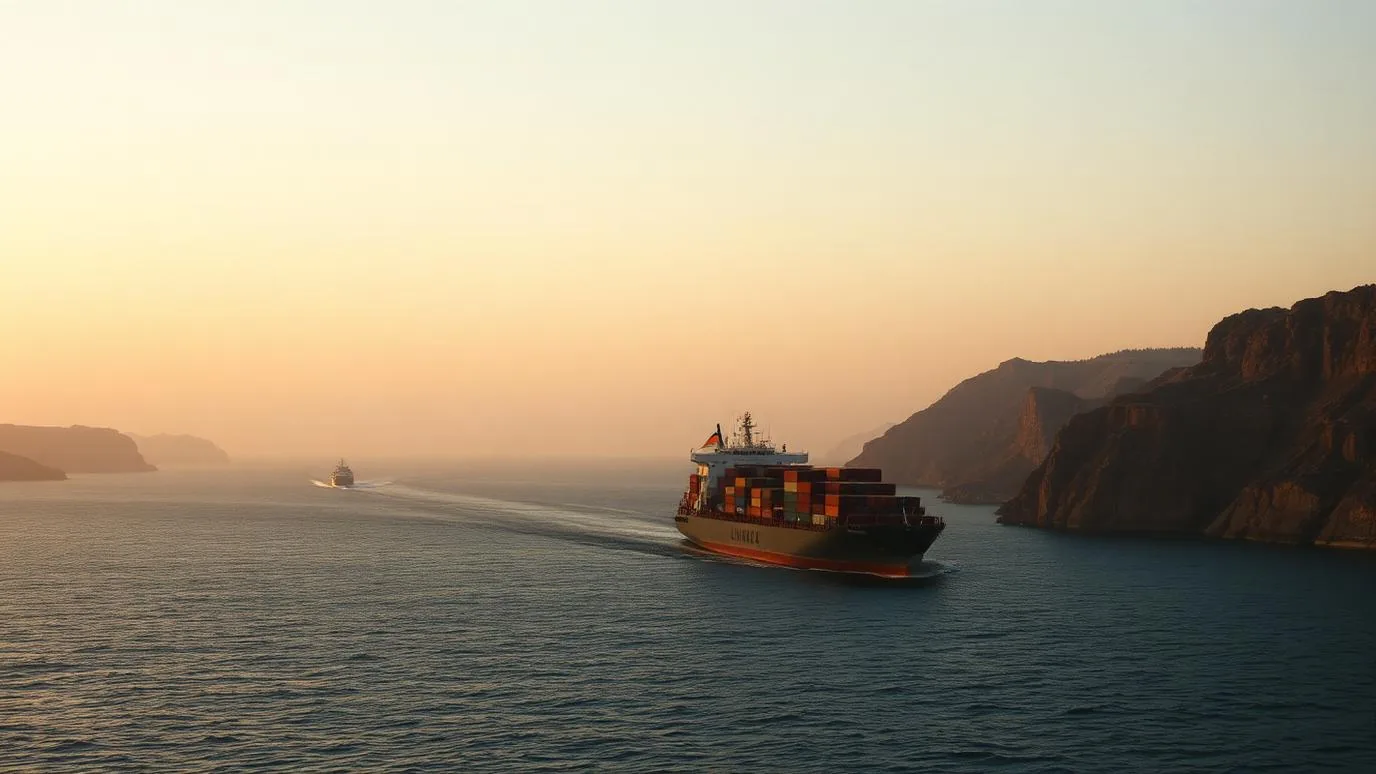
A cargo ship transiting the Strait of Hormuz was struck by an unidentified projectile in the past 24 hours, according to maritime security monitors tracking traffic through the waterway, the latest and most direct evidence yet that the shooting war between the United States and Iran has begun spilling directly onto commercial shipping lanes. No group has claimed responsibility, and it remains unclear whether the vessel was deliberately targeted or caught in the wider pattern of missile and drone activity that has intensified across the Gulf in recent weeks.
The ship's operator has not disclosed the extent of damage, and it is not yet known whether the vessel was carrying crude oil, refined products or dry cargo. What is already clear is the market reaction: shipowners, charterers and insurers are treating the incident as confirmation that the risk to Hormuz transits, long discussed in the abstract, has become concrete and immediate.
Why one strait carries this much weight
The Strait of Hormuz is barely 33 kilometres wide at its narrowest point, with navigable shipping channels narrower still, and it is the only sea route out of the Persian Gulf. Roughly a fifth of global oil consumption and a substantial share of the world's liquefied natural gas, most of it Qatari, moves through this single corridor. There is no practical alternative sea route; pipeline capacity around the strait exists but covers only a fraction of what normally transits by tanker. That geography is why even a single unclaimed attack on a single vessel reverberates through freight and insurance markets far beyond the Gulf.
- War-risk insurance premiums for Hormuz transits, already elevated since the conflict began, are reported by shipbroking sources to have risen sharply again in the hours since the strike.
- Several major tanker operators are understood to be pausing new bookings through the strait pending clearer guidance from naval escorts and underwriters.
- Charter rates for vessels willing to accept the current risk premium have moved upward, a pattern consistent with previous periods of Gulf tension.
- The UK Maritime Trade Operations agency and equivalent US Navy advisories have both flagged the strait as an area of heightened risk in the past week.
Trump's reopening claim
President Trump said the strait could reopen 'literally by tomorrow', a claim that, if taken at face value, implies either an imminent ceasefire or a belief that shipping can resume safely even without one. Neither Iranian officials nor independent maritime security firms have offered anything close to that timeline, and the claim sits awkwardly alongside the fact that a vessel was struck within the same news cycle in which it was made. Statements of this kind from Washington have, in this conflict, tended to run ahead of verifiable developments on the water.
Insurers do not price a strait as open or closed. They price it by the day, against whatever happened in the previous 24 hours.
What rerouting actually costs
There is no meaningful rerouting option around Hormuz for vessels loading in the Gulf; ships either transit or they do not sail. That is different from disruptions in, say, the Red Sea, where vessels can divert around the Cape of Good Hope at a cost in time and fuel. A prolonged closure or informal deterrence of Hormuz transits would instead mean idled loadings, stranded cargoes and, for buyers dependent on Gulf crude and LNG, a scramble for alternative supply that global spare capacity may struggle to absorb quickly.
What to watch
- Whether the ship's flag state or operator identifies the projectile's origin, which would materially change how insurers and navies respond.
- Whether further incidents follow in the coming days, which shipping analysts regard as a more reliable signal than any single official statement.
- Movements in Brent crude and LNG spot prices, which are already responding to the heightened risk premium.
- Whether US or allied naval escorts increase their presence in the strait, a step that would itself signal how seriously the incident is being taken.
For now, the honest position is that a single unclaimed strike has done more to concentrate minds in shipping and insurance markets than several rounds of diplomatic statements, and that any claim about the strait's imminent reopening should be weighed against the fact that vessels are still being hit while those claims are made.
Was this helpful?
Elias Braun
Energy and Climate Editor, Lonic
Elias covers energy systems and industrial decarbonisation, with a background in grid planning for a European transmission operator.
- Energy systems
- Climate technology
- Infrastructure
Read our editorial standards or send a correction.
Related articles
Why Hormuz Shipping Insurance Is Repricing Global Trade Risk
A second tanker incident near the Strait of Hormuz has widened force majeure declarations across shipping, pushing insurers to reprice risk on a route carrying a fifth of world oil consumption.
How a Hormuz Disruption Turns Into an Inflation Problem for Central Banks
The transmission from a Strait of Hormuz disruption to oil and gas prices, inflation expectations and central bank policy is neither instant nor uniform. Here is how the mechanics actually work, and why Asian economies are the most exposed.

The Fractional COO Boom: Why Growing Companies Are Renting Operational Leadership
Search demand for fractional operating executives has climbed sharply. The model solves a real problem for companies between 20 and 200 people — when it is scoped correctly.

Trending Products 2026: Sustainable Toothbrushes, Glass Straws and What Is Driving Demand
Two unrelated products are climbing search charts for the same underlying reason. A look at what the sustainable consumer goods boom is actually rewarding.