Wildfire Evacuation Guide: What to Prepare Before the Warning Arrives
Most evacuation failures are not dramatic. They are ten minutes lost looking for documents. A practical, evidence-based checklist for households in fire-exposed regions.
 Elias Braun 7 min read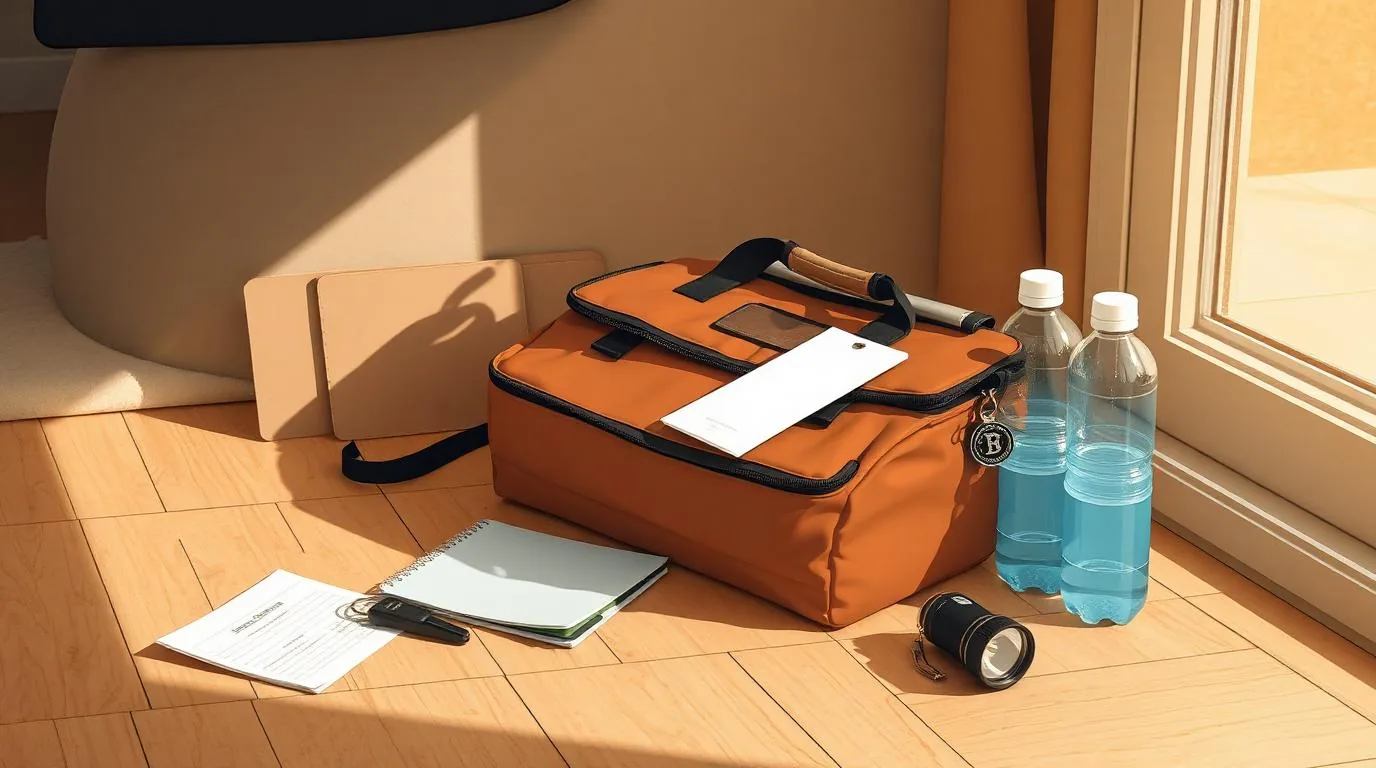
Post-incident reviews of wildfire evacuations across southern Europe, California and Australia keep producing the same finding: the households that leave late are rarely the ones who ignored the warning. They are the ones who received it and then spent twenty minutes deciding what to take. Preparation is not about stockpiling. It is about removing decisions from the worst possible moment to make them.
The go-bag, and what actually belongs in it
- Identity and legal documents — passports, residence papers, insurance policies, property deeds — in one waterproof folder, plus photographs of each stored in the cloud.
- Prescription medication for at least seven days, in original packaging with dosage visible.
- Two litres of water per person, plus food that needs no preparation.
- N95 or FFP2 masks. Smoke, not flame, causes the majority of wildfire health impacts.
- A torch, a power bank, a paper map of the region and a written list of phone numbers. Mobile networks fail early in fire zones.
- Sturdy shoes and long cotton or wool clothing. Synthetics melt.
Decisions to make while nothing is happening
Agree three things with everyone in the household, in advance and out loud: the trigger that means you leave, two separate routes out, and a meeting point outside the fire-exposed area. The trigger matters most. 'When it looks bad' is not a trigger. 'When an evacuation advisory is issued for our municipality, or when we can see flame on the ridge, whichever comes first' is.
Leaving early is not overreacting. Late evacuation through smoke on a single-lane road is the scenario that kills people.
Preparing the house itself
- Clear gutters and roof valleys. Ember ignition in accumulated debris destroys more houses than direct flame contact.
- Maintain a defensible space of at least five metres with no combustible material against exterior walls — no woodpiles, no gas bottles, no dry planters.
- Fit metal mesh over vents and under-floor openings to block ember entry.
- Close all windows, doors and shutters before leaving. An open window is an ember pathway.
- Leave gates unlocked and the property address visible so fire crews can enter.
During the evacuation
Drive with headlights on and windows closed, set ventilation to recirculate, and do not attempt to outrun a fire front on a road that runs parallel to it. If you become trapped in a vehicle, current guidance is to stop in the largest cleared area available, stay inside below window level under a wool blanket, and wait for the front to pass — a vehicle offers substantially more protection than open ground.
None of this is dramatic, and that is the point. Households that rehearse the procedure once a year leave within minutes of an advisory. In the seasons Europe is now experiencing, described in our coverage of this year's wildfires, those minutes are the whole margin.
Was this helpful?
Elias Braun
Energy & Environment Editor, Lonic
Elias covers energy systems and industrial decarbonisation, with a background in grid planning for a European transmission operator.
- Energy systems
- Climate technology
- Infrastructure
Read our editorial standards or send a correction.
Related articles
European Wildfires 2026: 325,000 Displaced and a Fire Season That Started Early
France and Spain are carrying the worst of a summer that arrived weeks ahead of schedule. The damage is severe, but the more important story is how the season is changing shape.
Hungary Shuts Its Only Nuclear Plant as the Danube Hits Record Lows
Hungary is closing the Paks nuclear plant for the first time in 44 years after record-low Danube levels left its cooling system unable to draw water from the river.

South Korea Records Its Hottest Day Ever as Seoul Issues First Severe Heat Alert
Yangsan hit 42.5C on 2 August, a new national record, as Seoul issued its first-ever top-level heat warning and Daegu passed 40C amid a punishing Asian heatwave.
The WMO Says El Nino Will Intensify Through October, Raising Global Heat Risk
The World Meteorological Organization forecasts El Nino intensifying through October 2026, with hotter-than-normal conditions likely across nearly every land area on Earth.