European Wildfires 2026: 325,000 Displaced and a Fire Season That Started Early
France and Spain are carrying the worst of a summer that arrived weeks ahead of schedule. The damage is severe, but the more important story is how the season is changing shape.
 Elias Braun 9 min read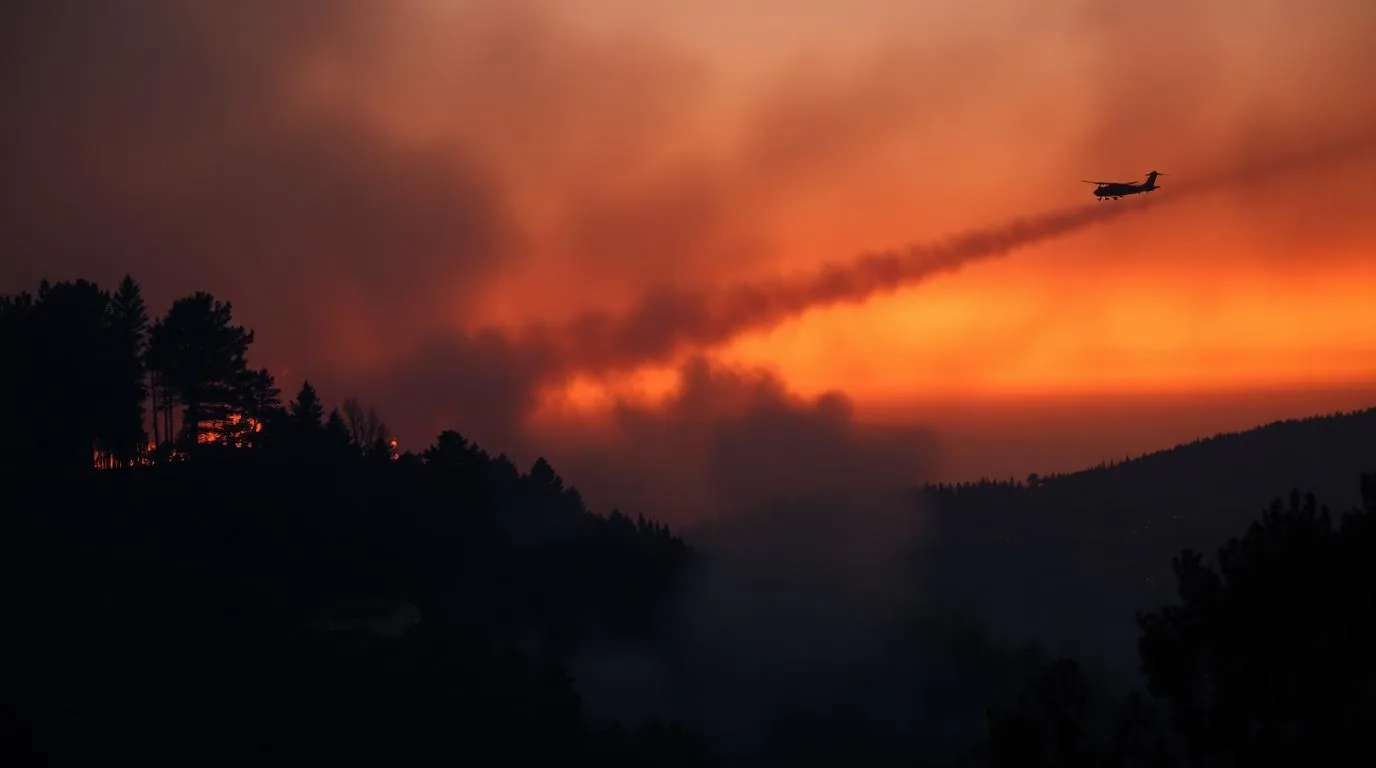
More than 325,000 people have been displaced by wildfires across France and Spain this summer, with at least fourteen confirmed deaths and burn scars now visible from orbit across Aquitaine, Catalonia and Galicia. Those are the headline figures. The structural story underneath them is that Europe's fire season now begins earlier, peaks harder and overlaps across countries that used to take turns.
Why simultaneity is the real problem
European wildfire response was built on mutual aid. When Portugal burns, Spanish and French aircraft fly west; when Greece burns, the flow reverses. The system assumes that peak demand in one country coincides with slack capacity in another. A prolonged heat dome sitting over the whole of southwestern Europe removes that assumption. Every national fleet is committed at once, and the EU's shared reserve — a few dozen aircraft — is nowhere near large enough to be the difference.
Mutual aid works when fires take turns. It fails the moment the continent burns on the same afternoon.
What made this season worse
- A multi-week heat dome that kept overnight temperatures high, denying crews the cool hours when fires normally lie down.
- Rainfall deficits through spring that left live fuel moisture at levels usually seen in late August.
- Rural depopulation and abandoned farmland, which converts former firebreaks into continuous fuel.
- Wind events that arrived during the hottest part of the day rather than after it.
The fourth point deserves emphasis. Fire behaviour is not linear in temperature; it is nonlinear in the combination of heat, wind and dryness. The mechanics of that combination are set out in our explainer on fire weather, and they are the reason a season can look ordinary in the statistics until the week it does not.
The economic bill
Tourism cancellations across Mediterranean coastal regions in peak season are the largest single line. Agricultural losses follow, with vineyards in southwestern France and olive groves in Catalonia both affected. Direct suppression costs — aircraft hours, crew deployment, military assistance — run into the hundreds of millions of euros. Insurance losses will take a year to settle and will feed directly into the price of cover for the next season, which is how climate risk usually reaches households: through premiums, not headlines.
What would actually reduce next year's damage
- Prescribed burning and mechanical fuel reduction at a scale roughly ten times current European practice.
- A permanent, jointly funded aerial fleet rather than a seasonal reserve topped up by national loans.
- Building codes and defensible-space rules enforced at the wildland–urban interface, where almost all structure loss occurs.
- Land-use policy that treats abandoned farmland as a fire hazard rather than a rural statistic.
None of these are technically difficult. All of them are politically slow, because their benefit is a fire that does not happen and their cost falls in a year when nothing is burning. Households in exposed regions cannot wait for that argument to resolve, which is why practical preparation — covered in our evacuation guide — remains the highest-return action available to individuals this summer.
Was this helpful?
Elias Braun
Energy & Environment Editor, Lonic
Elias covers energy systems and industrial decarbonisation, with a background in grid planning for a European transmission operator.
- Energy systems
- Climate technology
- Infrastructure
Read our editorial standards or send a correction.
Related articles
Amazon Deforestation Falls to Its Lowest Level in a Decade, Brazilian Data Shows
Brazil's Amazon deforestation figures for January to June hit their lowest point in ten years, though experts warn that degradation from fires and drought is outpacing the improvement.
Hurricane Season 2026 Forecast: What the Outlooks Actually Say
Seasonal hurricane outlooks are probabilistic tools, not predictions of where storms will strike. Here is what the hurricane season 2026 forecasts are and are not telling coastal communities.

Wildfire Evacuation Guide: What to Prepare Before the Warning Arrives
Most evacuation failures are not dramatic. They are ten minutes lost looking for documents. A practical, evidence-based checklist for households in fire-exposed regions.
Hungary Shuts Its Only Nuclear Plant as the Danube Hits Record Lows
Hungary is closing the Paks nuclear plant for the first time in 44 years after record-low Danube levels left its cooling system unable to draw water from the river.