Space Debris and the Growing Collision-Risk Problem in Low Earth Orbit
Tens of thousands of tracked objects and a much larger population of untrackable fragments now share low Earth orbit with an expanding satellite population. The maths of that crowding is getting harder to ignore.
 Dr. Ivan Petrov 8 min read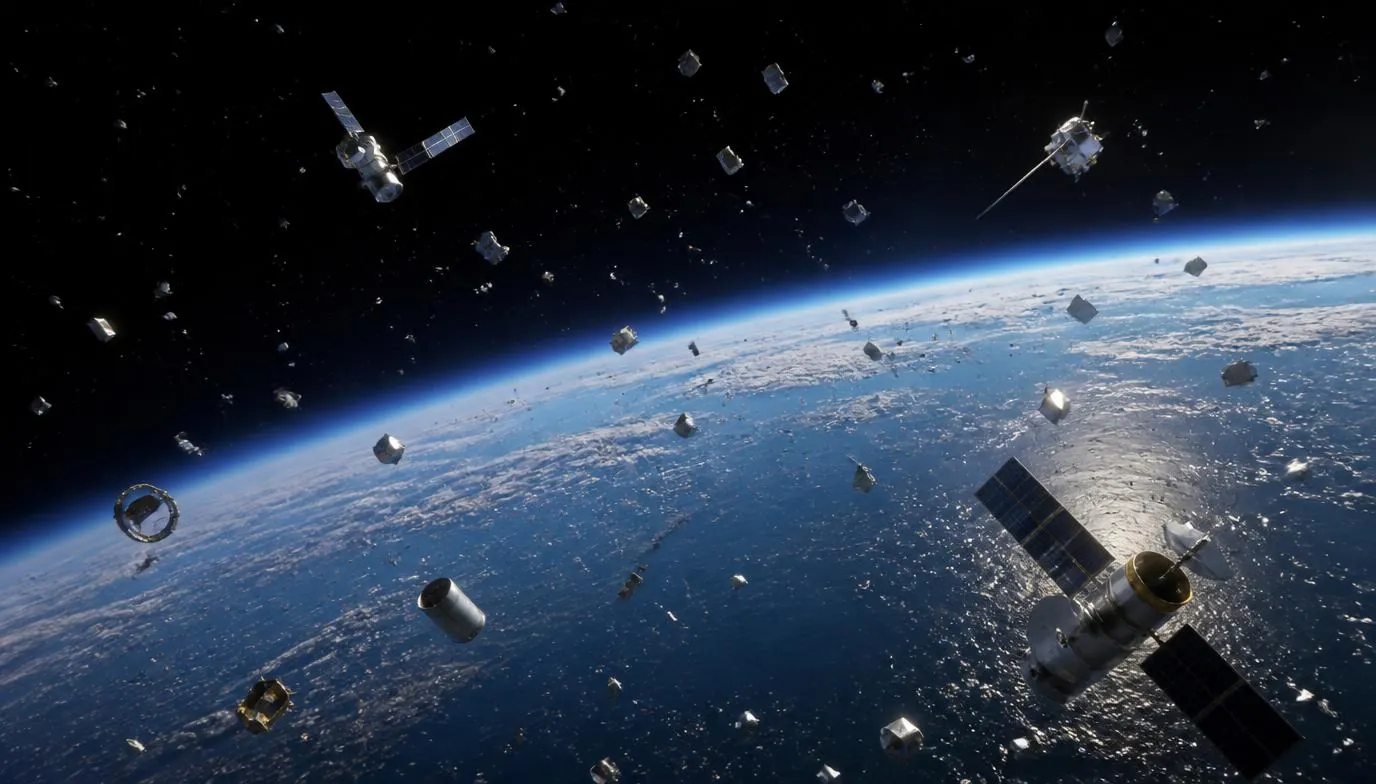
Low Earth orbit, the region up to roughly 2,000 kilometres above the Earth's surface where the great majority of active satellites operate, has become noticeably more crowded over the past decade, driven largely by the rapid deployment of large satellite constellations. Alongside those active satellites sits a much larger population of debris: spent rocket stages, defunct satellites, fragments from past collisions and anti-satellite weapons tests, and small pieces of hardware shed during normal operations. Tracking agencies catalogue tens of thousands of objects large enough to monitor individually, and estimate a far larger population of untracked fragments too small to follow reliably but still large enough to destroy a functioning satellite on impact.
Why size is a misleading measure of risk
Objects in low Earth orbit travel at roughly seven to eight kilometres per second, meaning even a debris fragment a few centimetres across carries kinetic energy comparable to a small explosive on impact. Objects below about ten centimetres are generally too small for current ground-based tracking systems to catalogue individually, which means operators of satellites and crewed spacecraft cannot manoeuvre to avoid them in the way they can for larger tracked objects. This untrackable population, estimated to number in the hundreds of thousands to millions of fragments, is in some ways the more concerning part of the problem precisely because it cannot be avoided, only shielded against or statistically tolerated.
- Roughly 30,000-plus objects are large enough (generally above about ten centimetres) to be individually tracked and catalogued.
- Untrackable fragments below that threshold are estimated to number from the hundreds of thousands into the millions.
- A 2007 Chinese anti-satellite weapons test and a 2009 collision between an active and a defunct satellite each generated large, long-lived debris fields still being tracked today.
- Large satellite constellations have substantially increased the number of active objects sharing low Earth orbit and, correspondingly, the number of collision-avoidance manoeuvres operators must perform.
The Kessler syndrome, properly understood
Kessler syndrome — the scenario in which collisions between objects generate debris that goes on to cause further collisions, in a self-sustaining cascade — is often invoked in popular coverage as an imminent, sudden event. Most specialists in orbital debris describe it more accurately as a slow-building risk that increases gradually as object density rises in particular orbital bands, rather than a single catastrophic tipping point that occurs on a specific date. Certain congested altitude bands are of greater concern than low Earth orbit as a whole, and the risk is unevenly distributed rather than uniform.
It is less a cliff edge than a rising tide. The concern is not that one collision suddenly renders an orbit unusable, but that the background collision probability keeps climbing as more objects accumulate.
What operators and regulators are doing about it
A number of mitigation measures are already in routine use or under active development, though none is a complete solution on its own. Satellite operators are increasingly expected to plan for controlled deorbiting of spacecraft at the end of their operational life, and international guidelines — not universally binding, and not universally followed — recommend deorbiting within a set number of years of mission completion. Active debris removal missions, which use robotic arms, nets or other capture mechanisms to physically remove large defunct objects from orbit, have moved from concept to early demonstration but remain expensive and limited in scale relative to the size of the debris population.
- End-of-life deorbiting guidelines exist internationally but compliance varies and enforcement mechanisms are limited.
- Active debris removal missions have demonstrated capture of individual large objects but operate at a scale far below what would be needed to meaningfully reduce the total debris population.
- Collision-avoidance manoeuvres by operators of large constellations have become routine, increasing operational cost and complexity.
- Improved ground-based and space-based tracking is gradually extending the size threshold at which objects can be reliably catalogued.
None of this suggests low Earth orbit is on the verge of becoming unusable. It does suggest that the margin for error is narrowing in the most congested altitude bands, and that debris mitigation — an unglamorous, largely regulatory and engineering problem — deserves a share of attention that has tended to go instead to the more visible business of launching new satellites.
Was this helpful?
Dr. Ivan Petrov
Science Editor, Lonic
Ivan holds a doctorate in condensed matter physics and worked on superconducting qubit error correction before moving into science journalism.
- Quantum computing
- Physics
- Research policy
Read our editorial standards or send a correction.
Related articles

Fire Weather Explained: The Science Behind Europe's Worsening Wildfire Seasons
Heat domes, vapour pressure deficit and fuel moisture sound technical. They are also the three numbers that decide whether a spark becomes a headline.

Japan Earthquake 2026: What We Know as 300,000 Are Told to Leave
Thirteen deaths confirmed, hundreds of thousands under evacuation instruction and a rescue window measured in days. A clear account of the situation and the response.
Earthquake Preparedness: What Japan Does That Other Countries Still Do Not
Similar magnitudes produce wildly different death tolls. The difference is almost entirely engineering, drills and building codes enforced over decades.
A Decades-Old Flaw Let Researchers Rewrite DNA Evidence Files Using Claude
A long-standing vulnerability in widely used Thermo Fisher forensic DNA software let researchers add or remove profiles from evidence files, exposing the fragility of digital chain of custody.